Dragons · Oxfordshire
The Dragon of Dragon Hill
Dragon Hill, below the White Horse at Uffington, on the Berkshire Downs
Family-friendly
High on the downs above the Vale, the great White Horse gallops across the hillside, cut into the white chalk. Just below its nose the hill falls away into a deep hollow called the Manger. And at the foot of the slope, beside the old road, stands a curious round hill with a flat top, like a table set out on the grass. This is Dragon Hill.
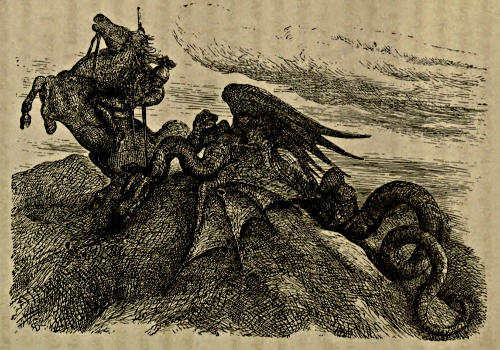
The people of the Vale had no doubt how it got its name. Here, they said, in the old times, St George fought the dragon and killed it. In Uffington they didn't call him Saint George, though. To them he was King George.
Nobody wrote down how the fight went, or where the dragon came from. But they did tell you what happened afterwards. When the dragon died, its blood poured out over the top of the hill and made a pool there. It ran down the steps on the far side. And where the dragon's blood touched the ground, nothing would ever grow again, not so much as a thistle.
The bare white patch is still there on the top of the hill. If you climb up and stand on it, you're standing where, so the people of the Vale said, the dragon's blood ran out.
Job Cork, an Uffington man who kept sheep on White Horse Hill for fifty years, put the story into a song. In it he imagines a stranger riding by, who asks an old shepherd what he has heard about the hill. The shepherd answers:
Ah, Zur, I can remember wellThe stories the old voke do tell—Upon this hill which here is seenMany a battle there have been.If it is true as I heard zay,King Gaarge did here the dragon slay,And down below on yonder hillThey buried him as I heard tell.Job Cork, shepherd of White Horse Hill, as printed by Thomas Hughes in 1859
So come up on a bright day and look for the bare chalk on the hilltop. Then look up at the White Horse above you, and decide for yourself which of them is the older.