Royal legends · Oxfordshire

Fair Rosamund and the Silken Thread

Woodstock and Godstow, just north of Oxford

Family-friendly

In the days of King Henry the Second there lived a lady so lovely that people called her Rosamund, the Rose of the World. The king loved her dearly. But Henry already had a queen, Eleanor, and the old ballad calls her Rosamund's “deadly foe”.

So the king hid Rosamund away. At his palace in Woodstock, the chroniclers wrote, he had a bower made for her, built with such cunning that it was likened to the labyrinth that Daedalus built in the old Greek tale. Its passages turned and twisted and doubled back, and the old ballad says there were a hundred and fifty doors. No one could find the way in or out without a clue, a ball of thread to follow.

And they so cunninglye contriv'dWith turnings round about,That none but with a clue of thread,Could enter in or out.from the ballad of Fair Rosamond, printed in 1612

For a time the secret was kept. But the queen grew suspicious. The common report of the people, as Raphael Holinshed set it down, was that one day Eleanor spotted a silken thread that the king had drawn after him, caught on his foot, as he came out of Rosamund's chamber. She took hold of the end and followed it, turn after turn, through all the twisting ways, until it brought her at last to Rosamund's door.

What happened next, the tellers could not agree. The old chroniclers say only that the queen dealt with Rosamund so harshly that she did not live long afterwards. The ballad-makers told it more darkly: the queen held out a cup of poison, and though Rosamund knelt and begged to be sent to a nunnery instead, she was made to drink it.

However it ended, Rosamund was buried at Godstow, at the little nunnery by the Thames above Oxford. Her tomb stood in the middle of the nuns' church, covered with a silk cloth and lit with candles.
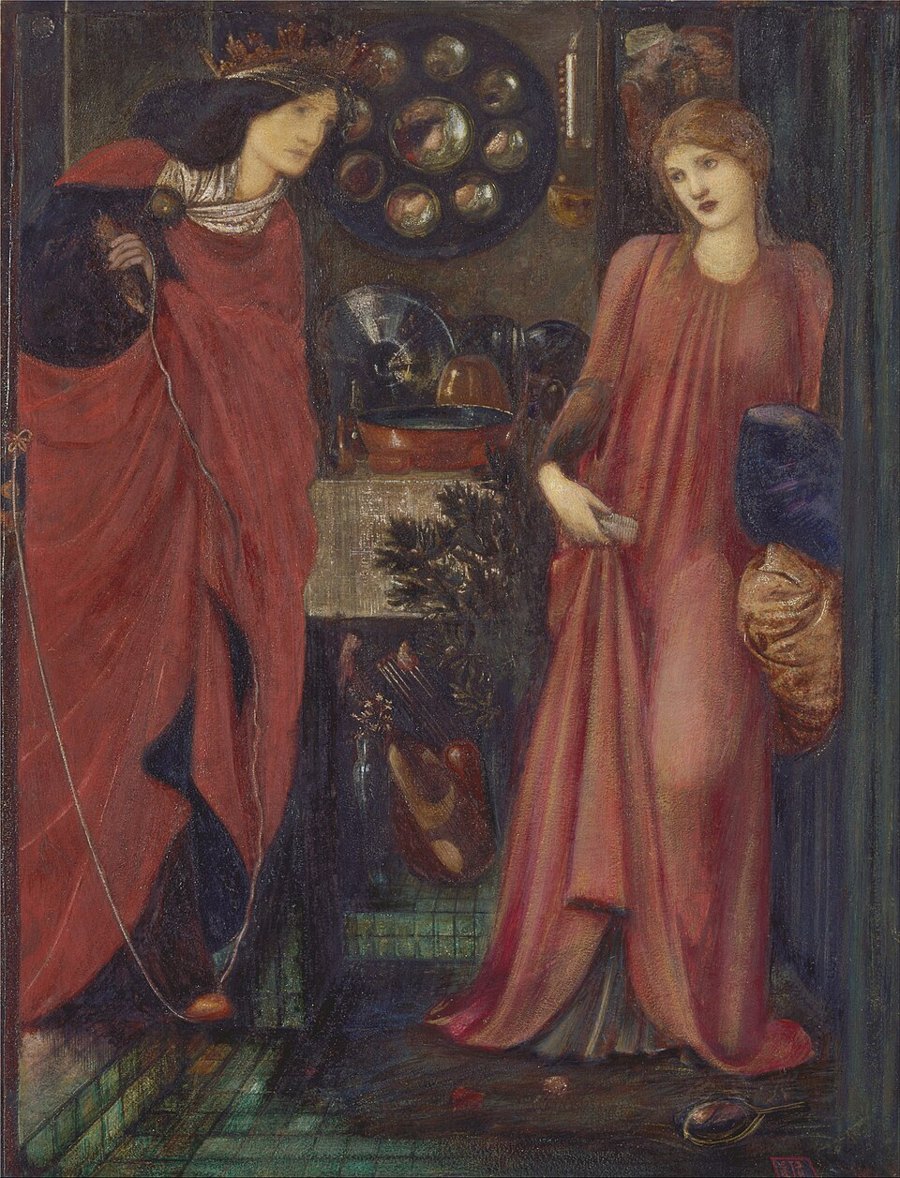
Plate II

Painting of Queen Eleanor, crowned and in a red cloak, holding a thread that trails across the floor, as she faces Rosamund, who stands in a pink gown in a small room full of treasures
Plate II. Queen Eleanor finds Rosamund, the thread still in her handEdward Burne-Jones, Fair Rosamund and Queen Eleanor, 1861. Public domain, via Wikimedia Commons.

What people said

  • Rosamund's bower. In 1718 the antiquary Thomas Hearne said that the foundations of a very large building could still be seen by the pool at Woodstock, and that people believed they were the remains of Rosamund's labyrinth.
  • The cup on the tomb. A cup was carved on Rosamund's tombstone at Godstow. When the stone was broken up after the nunnery closed, people said it was the cup she drank the poison from. Thomas Percy thought the carving was more likely a chalice, and that it may have started the poison story.
  • Her well. A spring in Blenheim Park, near the site of the old palace of Woodstock, is still called Fair Rosamund's Well. It already had the name in 1649: Robert Plot tells of poachers who fled past “Rosamonds well” on the night the Just Devil of Woodstock was at its worst.
  • A ghost at the Trout? In our own time the Trout Inn, across the river from Godstow, has claimed Rosamund as its ghost. We have found no old source for this. It is a modern local story.

Other tellings

  • The earliest bower. Ranulf Higden, a monk of Chester writing in the 1300s, is the first we have found to describe the bower. He calls it a chamber “of wonder craft” at Woodstock, made like the work of Daedalus, so that the queen should not find Rosamund. In his telling she simply “died soon after”. There is no thread and no poison.
  • A crueller version. A French chronicle of London from the same century tells a much crueller murder, and even pins it on the wrong queen. We leave it out here.
  • The thread from Rosamund's lap. In John Speed's history (1611) the thread comes from Rosamund herself. She was sitting outside with a ball of silk in her lap when she saw someone coming and fled indoors. The end of the silk was caught on her foot, and the ball unwound behind her for the queen to follow.
  • The wounded knight. In the ballad, printed by Thomas Deloney in 1612, the king leaves a knight called Sir Thomas to guard the bower while he goes to fight his rebel son in France. The queen's men wound the knight and take his clue of thread.
  • The dagger and the bowl. Later tellings have the queen offer Rosamund a choice of a dagger or a bowl of poison. [TODO: find the earliest telling with the dagger]

What the history says

Rosamund Clifford was real. She was the daughter of Walter de Clifford and became Henry II's mistress. She died in about 1176 (John Stow gives 1177) and was buried at Godstow nunnery, where her father was a benefactor. [TODO: confirm dates in a reliable modern history]

Her tomb really did stand in the middle of the nuns' choir, covered with a silk cloth and lit with candles. In 1191 Hugh, Bishop of Lincoln, saw it and ordered her body moved outside the church. Roger of Hoveden, who was alive at the time, recorded it.

The maze, the thread and the poison come from later writers. Even in 1765 Thomas Percy pointed out that none of the old chroniclers said she was poisoned. And by the time Rosamund died, Queen Eleanor was being kept prisoner by the king herself, after backing their sons' rebellion in 1173–74. Higden says so too. [TODO: confirm the dates of Eleanor's imprisonment]

Go and See

Where
The ruins of Godstow Nunnery stand in a field beside the Thames at Wolvercote, on the north-west edge of Oxford, by the Thames Path. Fair Rosamund's Well is in Blenheim Park, Woodstock.
Access
[TODO: access to the Godstow ruins (open field by the Thames Path; check landowner notices)] [TODO: Blenheim Park tickets and the route to Fair Rosamund's Well]
Allow
[TODO: a riverside walk to Godstow from Port Meadow, and how long it takes]
Families
Told gently here. The old ballad ends with a cup of poison, so you may want to read it first if your children are sensitive.

51.7783° N, 1.2999° W · Open in OpenStreetMap

Sources

  1. Ranulf Higden, Polychronicon, book VII (14th century), with John Trevisa's English translation, ed. J. R. Lumby, Rolls Series vol. 8 (1865). The earliest account of the bower that we have found. Internet Archive.
  2. Raphael Holinshed, Chronicles (1577; 1587 edition, vol. iii, p. 115), and John Speed, History of Great Britain (1611), both as quoted by Thomas Percy. The earliest tellings with the thread that we have found.
  3. John Stow, Annales (1631 edition), pp. 154 and 159, as quoted by Percy; includes Stow's translation of Roger of Hoveden on the tomb in 1191.
  4. Thomas Deloney, “Fair Rosamond”, in Strange Histories (1612), reprinted with notes in Thomas Percy, Reliques of Ancient English Poetry (1765), vol. 2. The earliest telling with the poison cup that we have found, and the source of the verse above. Internet Archive.
  5. The French Chronicle of London (14th century), translated by H. T. Riley in Chronicles of the Mayors and Sheriffs of London (1863), pp. 232–234. Internet Archive.
  6. The Trout Inn's ghost story is modern. We found it only on the inn's own website and on Dark Oxfordshire, as cited by Haunted Hotels UK.
  7. Robert Plot, The Natural History of Oxford-shire (1677), p. 209, for the name Rosamond's Well. Internet Archive.
  8. Plate II: Edward Burne-Jones, Fair Rosamund and Queen Eleanor, 1861. Public domain, via Wikimedia Commons.

This is a legend, told as people told it. Spotted something wrong? Tell us.