Standing stones · Witches · Oxfordshire

The King Who Became a Stone

The Rollright Stones, near Long Compton, on the Oxfordshire and Warwickshire border

Family-friendly

Long ago, so the people of Long Compton and Little Rollright used to say, a king set out at the head of his army to conquer the whole of England. Nobody remembers his name. He marched up the long hill above Long Compton, and he was only a few steps from the top, where the village would come into sight in the valley below, when the Witch who owned that ground stood in his way.

She looked him up and down and made him a promise.

Seven long strides shalt thou take, and—If Long Compton thou canst see,King of England thou shalt be.

The king laughed. The village lay just over the brow, and seven strides would carry him there with room to spare. He called out boldly:

Stick, stock, stone,As King of England I shall be known!

And off he strode, one, two, three, all the way to seven. But on the seventh stride there was no village below him. A long mound of earth had risen up in front of him and hidden Long Compton from view. It is still there, by the King Stone, to this day. Then the Witch spoke again:

As Long Compton thou canst not seeKing of England thou shalt not be.Rise up, stick, and stand still, stone,For King of England thou shalt be none,Thou and thy men hoar stones shall beAnd I myself an eldern-tree.

And so it happened. The king turned to stone where he stood, beside the mound. His army turned to stone in a ring behind him, and they are the King's Men. A little way off, a handful of his knights had slipped away from the others to whisper and plot against him, and they turned to stone with their heads together. They are the Whispering Knights. The Witch became an elder tree and stayed close by to keep watch over them all.

But the old people said the story isn't finished. One day the spell will break. The stones will turn back into flesh and blood, and the king will wake as an armed warrior and lead his army out to rule over all the land.
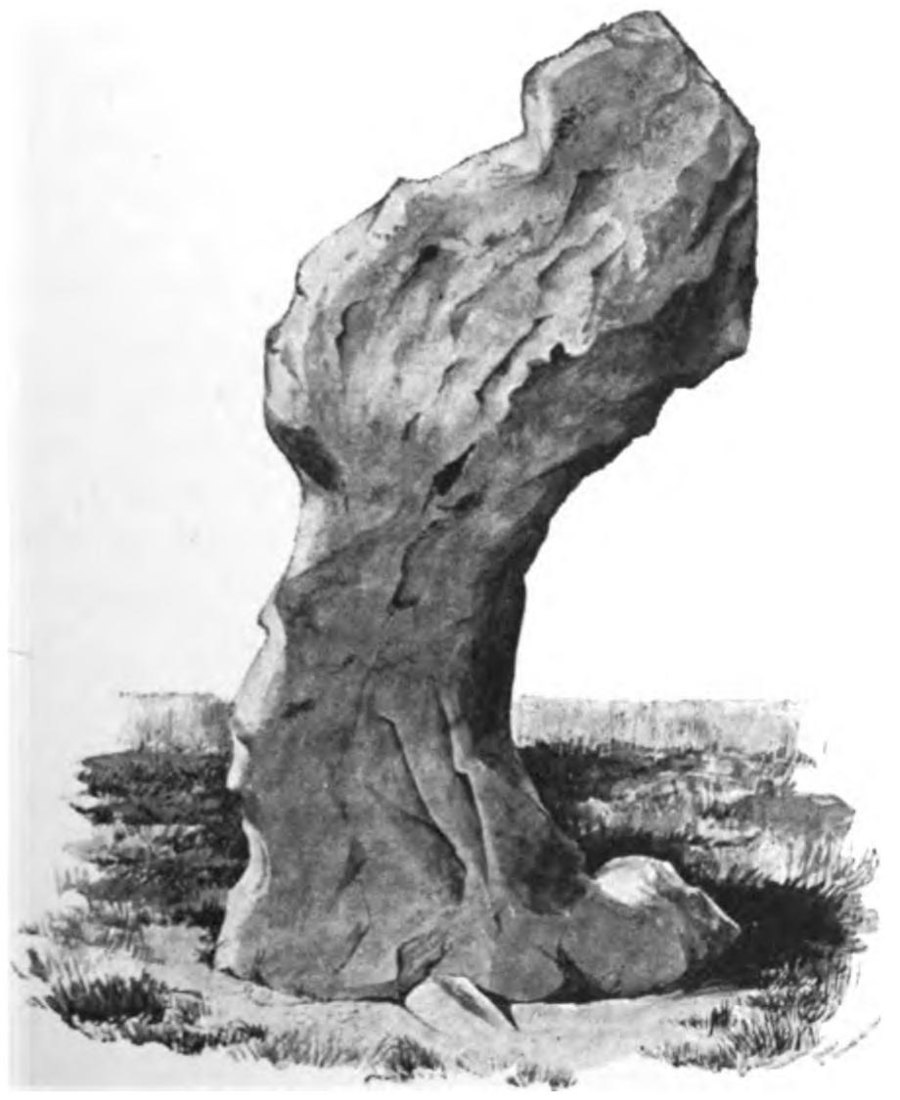
Plate I

Drawing of the King Stone, a tall, weathered standing stone that leans forward at the top, standing in rough grass
Plate I. The King StonePlate III from Arthur J. Evans, Folk-Lore (1895). Public domain, via the Internet Archive.

What people said

  • Nobody can count them. Men came from far away to count the King's Men, and never got the same number twice. A baker once put a penny loaf on every stone so he could count the loaves instead, but however many he laid down, one stone was always left without one. “The man will never live who shall count the stones three times and find the number the same.”
  • They go down to drink. At midnight, when the clock strikes twelve, the King's Men and the Whispering Knights go down the hill to drink at a spring in Little Rollright Spinney. Some said they went only on saints' days. Others said the King goes too, “when he hears the clock strike twelve”, and since he can't hear the clock, he stays where he is.
  • The Whispering Knights tell the future. Girls working in the fields at barley harvest would go up at dusk and put an ear to the cracks in the stones to hear them whisper. One old woman told Evans she had heard them “time and again—but perhaps, after all, it was only the wind.”
  • The stones won't stay away. Once the great flat capstone of the Whispering Knights was dragged down to make a bridge over the brook. It took a score of horses, and the harness broke. Every night the stone turned itself over onto the grass, so after three nights they took it back, and a single horse pulled it up the hill with ease.
  • The elder bleeds. The elder tree is the Witch, and if you cut it while it is in blossom, it bleeds. On Midsummer Eve people used to stand in a circle at the King Stone and cut the elder, and as it bled, “the King moved his head.”
  • Fairies dance round the King Stone. A Long Compton man said he had seen them dancing at night, “little folk like girls to look at”. Children used to put a flat stone over a hole in the bank by the King Stone to keep the fairies in, and found it turned over every morning.
  • Chips for luck. People chipped bits off the King Stone to carry for luck, and soldiers took them to be “good for England in battle”. But a carter who swore he'd take a piece “though his wheel locked” found that his wheel would not turn again.

Other tellings

  • The king usually has no name. Once he was called King Charles, another man called him “King Billy”, and in 1876 an old man born at Great Rollright called him “a Danish king”.
  • In some accounts the Witch is called Mother Shipton.
  • Sometimes it is the king himself who says “Seven long strides shall I take.” One version of the Witch's curse has “Fall down, king” instead of “Rise up, stick”, and another has “Rise up, mound”.
  • Some say the Whispering Knights are not plotting at all, but praying.
  • In other tellings of the capstone story it was a miller from Long Compton who took it to dam his mill-stream, or a farmer who wanted it for an outhouse. Each time it brought trouble until it was taken back. Tellers couldn't agree how many horses it took: forty and one, twenty-one and three, twelve and two, eight and one.
  • Percy Manning owned a copy of Robert Plot's Natural History of Oxfordshire (2nd edition, 1705) with handwritten notes in a hand of the same period, which he thought was “probably the earliest recorded version of these rhymes”. In it there is no witch at all. A Danish general says “If Long Compton I cou'd see / Then King of England I shou'd be”, and a Saxon general answers “Then rise up Hill & stand fast Stone— / For King of England thou'lt be none.”
  • Manning's collector, Thomas Carter, heard in the 1890s that the stones went down to the brook to drink at twelve o'clock on New Year's Eve, and a Charlbury man told him of a baker who put a loaf on every stone and counted seventy-two.
  • The legend is old. William Camden heard it in the 1580s: the country people told him the tallest stone was “the King”, who would have been King of England if he had once seen Long Compton. William Stukeley wrote down the rhyme in 1743 and said the locals “take it very ill if anyone doubts of it”.

What the history says

The three groups of stones are much older than any king of England, and they weren't all raised at the same time. The Whispering Knights are what is left of a burial chamber from the early Neolithic. The King's Men are a stone circle from the later Neolithic. The King Stone is harder to date. Archaeologists think it was probably set up in the Bronze Age, perhaps to mark a burial ground. [TODO: confirm dates against Historic England list entry 1018400]

The road between the King Stone and the circle is an old one, and it is still the county boundary. The circle is in Oxfordshire, and the King Stone is just over the line in Warwickshire.

Go and See

Where
Beside the minor road from the A3400 towards Little Rollright, about 3 miles north of Chipping Norton. The King Stone is across the road from the circle, and the Whispering Knights are a short walk along a field edge.
Access
Usually open all year. Entry is £2 for adults and £1 for children aged 7 to 16. Pay online, by QR code on site, in the honesty box (cash, in daylight) or to the warden. It may close for events or maintenance. Until 6 November 2026 there is no access from the A44 because of roadworks.
Allow
About an hour to walk round all three groups.
Families
A gentle tale, fine for young children. The ground is fairly level, and the paths and gates suit wheelchairs and pushchairs. Keep dogs on leads and out of the circle. Parking is in two small laybys, which fill quickly.

Visiting details checked 24 October 2026 with The Rollright Trust, rollrightstones.co.uk. Always check before you travel.

51.9757° N, 1.5709° W · Open in OpenStreetMap

Sources

  1. Arthur J. Evans, “The Rollright Stones and their Folk-Lore”, Folk-Lore, vol. 6 (1895), pp. 6–53. Our main source for the tale, the rhymes and the beliefs, which Evans took down from people living near the stones. Read it free at the Internet Archive.
  2. William Camden, Britannia (1586), in Philemon Holland's English translation (1637), p. 374, as quoted by Evans. The earliest telling we have found.
  3. William Stukeley, Abury (1743), pp. 13 and 83, as quoted by Evans.
  4. Percy Manning, “Stray Notes on Oxfordshire Folklore”, Folk-Lore, vol. 13 (1902), pp. 288–295. Internet Archive.
  5. Historic England, National Heritage List entry 1018400, “The Rollright Stones” (scheduled monument).
  6. Visiting details: The Rollright Trust, rollrightstones.co.uk, checked 24 October 2026.
  7. Plate I: Plate III from Arthur J. Evans, Folk-Lore (1895). Public domain, via the Internet Archive.

This is a legend, told as people told it. Spotted something wrong? Tell us.